.png)
TAX TALK
CA. NARESH JAKHOTIA
Chartered Accountant
Seller should obtain PAN if bill amount exceeds Rs. 2 Lakh
Query 1]
Please give some light on Notification No. S.O. 3545(e) on reporting in AIR by audited concerns. Issue is, if sale invoice is each below 2 Lakh and such sale to one party during the year may be in lakhs but each is below rupees two lakh and all payments are in cash (each below 20000),
- Should seller ask for PAN or form 60 even if each transaction is below 2 lacs?
- Is there any responsibility of CA to report such sale or purchases (each invoice is below Rs. 2 Lakh) but yearly cash transaction is above 2 Lakh (including all invoices, no single transaction is above 2 lacs).
Opinion:
“Taxes grow without rain” -Old Jewish Proverb
Year after year, every Government is trying hard to regulate the generation & flow of black money in the economy. It is believed that controlling the black money would also results in controlling the illegal activities. In order to keep a proper track of high value transactions, quoting of PAN has been made mandatory in number of transactions.
Under Rule 114B of the Income Tax Rules-1962, quoting of PAN is mandatory for the following transactions:
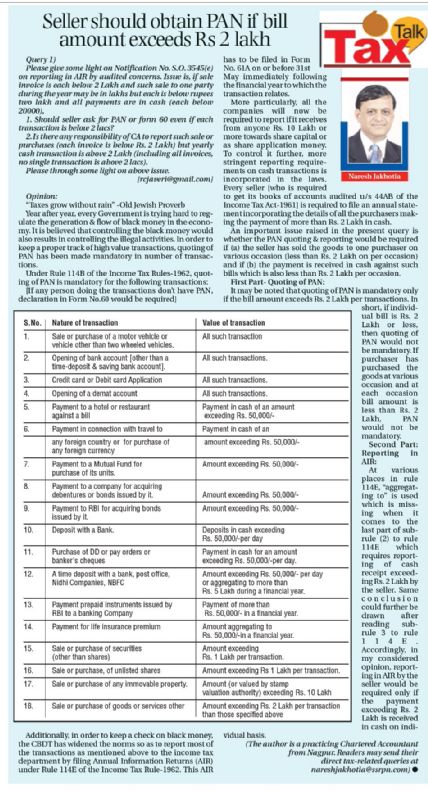
| S.No. | Nature of transaction | Value of transaction |
| 1. | Sale or purchase of a motor vehicle or vehicle other than two wheeled vehicles. | All such transactions. |
| 2. | Opening of bank account [other than a time-deposit & saving bank account]. | All such transactions. |
| 3. | Credit card or Debit card Application | All such transactions. |
| 4. | Opening of a demat account | All such transactions. |
| 5. | Payment to a hotel or restaurant against a bill | Payment in cash of an amount exceeding Rs. 50,000/- |
| 6. | Payment in connection with travel to any foreign country or for purchase of any foreign currency | Payment in cash of an amount exceeding Rs. 50,000/- |
| 7. | Payment to a Mutual Fund for purchase of its units. | Amount exceeding Rs. 50,000/- |
| 8. | Payment to a company for acquiring debentures or bonds issued by it. | Amount exceeding Rs. 50,000/- |
| 9. | Payment to RBI for acquiring bonds issued by it. | Amount exceeding Rs. 50,000/- |
| 10. | Deposit with a Bank. | Deposits in cash exceeding Rs. 50,000/-per day |
| 11. | Purchase of DD or pay orders or banker's cheques | Payment in cash for an amount exceeding Rs. 50,000/-per day. |
| 12. | A time deposit with a bank, post office, Nidhi Companies, NBFC | Amount exceeding Rs. 50,000/- per day or aggregating to more than Rs. 5 Lakh during a financial year. |
| 13. | Payment prepaid instruments issued by RBI to a banking Company | Payment of more than Rs. 50,000/- in a financial year. |
| 14. | Payment for life insurance premium | Amount aggregating to Rs. 50,000/-in a financial year. |
| 15. | Sale or purchase of securities (other than shares) | Amount exceeding Rs. 1 Lakh per transaction. |
| 16. | Sale or purchase, of unlisted shares | Amount exceeding Rs 1 Lakh per transaction. |
| 17. | Sale or purchase of any immovable property. | Amount (or valued by stamp valuation authority) exceeding Rs. 10 Lakh |
| 18. | Sale or purchase of goods or services other than those specified above | Amount exceeding Rs. 2 Lakh per transaction |
Additionally, in order to keep a check on black money, the CBDT has widened the norms so as to report most of the transactions as mentioned above to the income tax department by filing Annual Information Returns (AIR) under Rule 114E of the Income Tax Rule-1962. This AIR has to be filed in Form No. 61A on or before 31st May immediately following the financial year to which the transaction relates.
More particularly, all the companies will now be required to report if it receives from anyone Rs. 10 Lakh or more towards share capital or as share application money. To control it further, more stringent reporting requirements on cash transactions is incorporated in the laws. Every seller [who is required to get its books of accounts audited u/s 44AB of the Income Tax Act-1961] is required to file an annual statement incorporating the details of all the purchasers making the payment of more than Rs. 2 Lakh in cash.
An important issue raised in the present query is whether the PAN quoting & reporting would be required if (a) the seller has sold the goods to one purchaser on various occasion (less than Rs. 2 Lakh on per occasion) and if (b) the payment is received in cash against such bills which is also less than Rs. 2 Lakh per occasion.
First Part- Quoting of PAN:
It may be noted that quoting of PAN is mandatory only if the bill amount exceeds Rs. 2 Lakh per transactions. In short, if individual bill is Rs. 2 Lakh or less, then quoting of PAN would not be mandatory. If purchaser has purchased the goods at various occasion and at each occasion bill amount is less than Rs. 2 Lakh, PAN would not be mandatory.
Second Part: Reporting in AIR:
At various places in rule 114E, “aggregating to” is used which is missing when it comes to the last part of sub-rule (2) to rule 114E which requires reporting of cash receipt exceeding Rs. 2 Lakh by the seller. Same conclusion could further be drawn after reading sub-rule 3 to rule 114E. Accordingly, in my considered opinion, reporting in AIR by the seller would be required only if the payment exceeding Rs. 2 Lakh is received in cash on individual basis.
[The author is a practicing Chartered Accountant from Nagpur. Readers may send their direct tax related queries at
SSRPN & Co
10, Laxmi Vyankatesh Apartment
C.A. Road, Telephone Exch. Square
Nagpur-440008
or email it at nareshjakhotia@ssrpn.com]